Start here
Public · Open source
Embedded Runtime
Import Heddle directly into your TypeScript or Node.js backend. Your product owns the surrounding execution lifecycle, tools, storage, credentials, policy, product state, and UI.
@heddleagent/runtimeHeddle gives product teams reusable agent execution: durable conversations, tools and MCP, approvals, background work, artifacts, and agent run management. Embed the runtime in your backend today, or place it behind a compatible Execution Host when the agent needs its own isolated environment. Your product keeps control of identity, data, policy, effects, and UI.
Integration shapes
Embed Heddle directly in your backend. Add Agent Run Management when clients need stable run IDs, streaming, replay, cancellation, approvals, or reconnection. Move the same runtime behind a compatible host only when execution needs its own process, language-neutral interface, trust boundary, or isolated workstation.
Start here
Public · Open source
Import Heddle directly into your TypeScript or Node.js backend. Your product owns the surrounding execution lifecycle, tools, storage, credentials, policy, product state, and UI.
@heddleagent/runtimeOptional lifecycle layer
Public · Open source
Heddle still runs in your own server or worker. Give each execution a stable run identity and reusable lifecycle for streaming, replay, cancellation, approvals, reconnection, and terminal settlement. Your product still owns the process and infrastructure.
@heddleagent/runtime/runsOptional deployment boundary
Public adopter contract · Private reference implementation
Run the same Heddle runtime in a separately deployed, isolated environment and invoke it through a language-neutral contract, without giving the runtime your product database credentials.
@heddleagent/execution-host-clientThe Execution Host adopter contract and integration packages are public. The current compatible host and managed AgentCore deployment are private research. Heddle does not currently offer a public managed Execution Host or cloud service.
Clear responsibility boundaries
Heddle handles reusable agent mechanics without becoming your application framework or taking over your product decisions.
The reusable mechanics between a model call and an agentic experience people can trust.
Persist sessions across turns, resume work later, compact long histories, and keep conversation behavior consistent as your product grows.
Pause for product-owned decisions and expose understandable activity, traces, artifacts, tool outcomes, and safe typed failures.
Bring native product tools, reusable Agent Skills, and curated MCP-backed capabilities into one host-controlled execution model.
Keep Heddle in infrastructure you operate while giving each execution a stable run identity, ordered events, replay, cancellation, approval resolution, reconnection, and one truthful terminal outcome.
Case studies
These case studies document where Heddle has been tested inside real products—what worked, what changed, and where the product/runtime boundary belongs. Some describe current research systems; others preserve lessons from historical deployments.
Hosted execution proof
Lucid
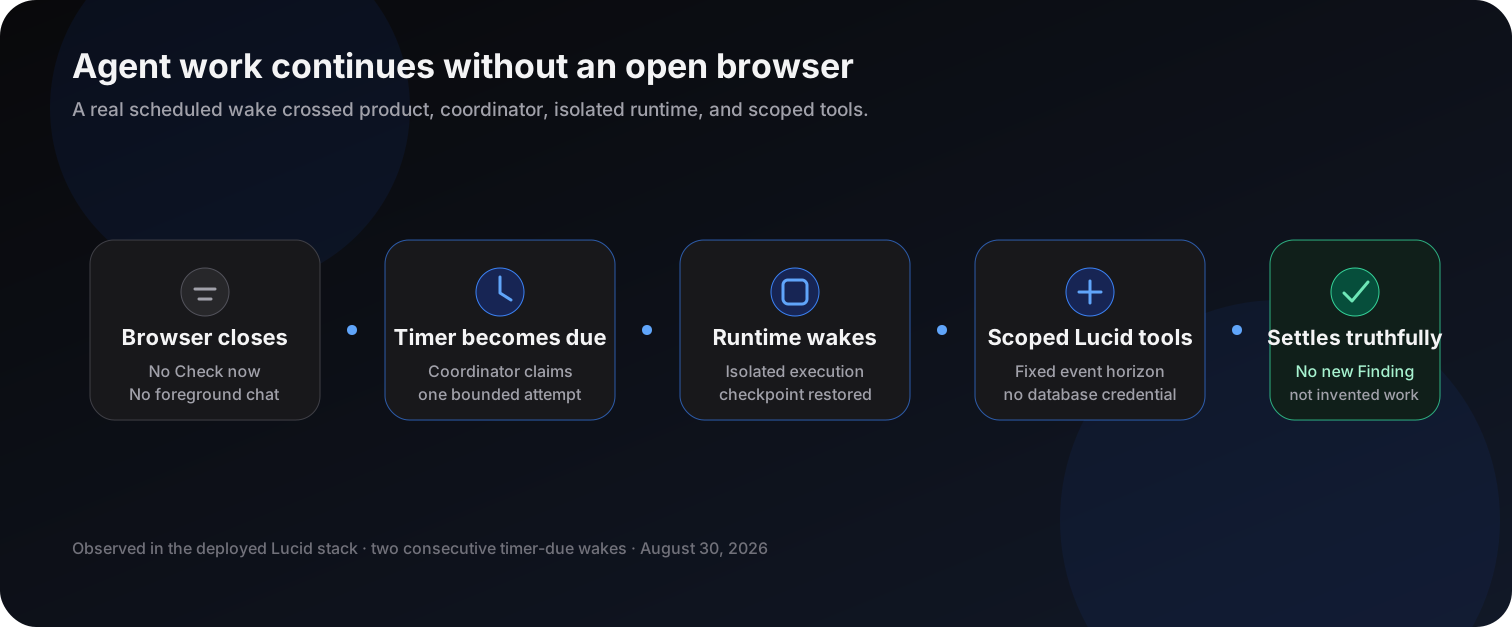
Experimental deployment · observed hosted executionAn experimental delegated-discovery workspace where one personal Agent follows an Interest, checks for useful information, and returns grounded Findings or an explicit no-action outcome.
Lucid proved that a product-owned personal Agent could wake on schedule, enter an isolated Heddle runtime, inspect only a fixed product scope, and settle truthfully—even when there was no useful Finding to return.
Integration retrospective
SlideX
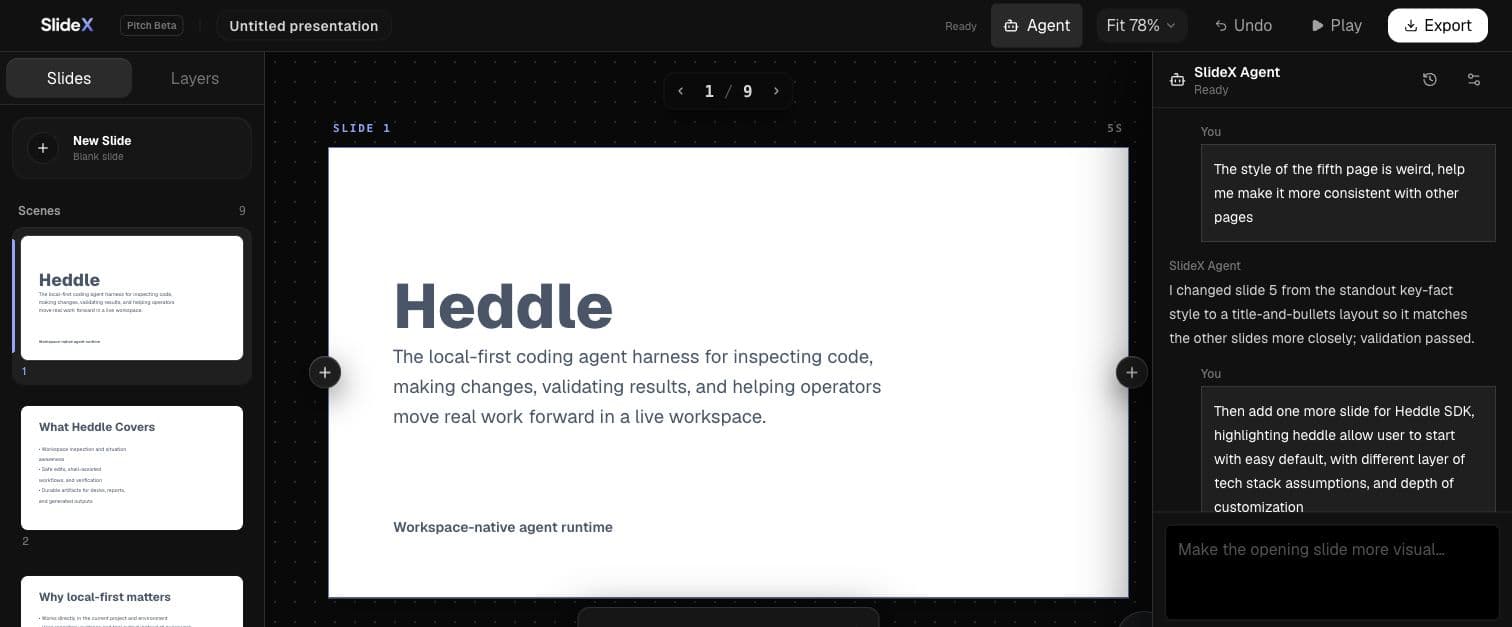
Historical deployment · first third-party integrationA browser presentation workspace that integrated a conversational agent for creating and revising real decks.
In July 2026, SlideX deployed a Heddle-powered conversational presentation agent. The hosted product has since been retired as SlideX moved back toward local operation, but the integration became the pressure test that reshaped Heddle into a reusable SDK.
working/NOW.md
Current focus, evidence, open questions, and the next sensible move.
memory/
Stable preferences, conventions, and durable user knowledge.
Next wake
Recover, reconsider, act within authority, or honestly do nothing.
Research direction
Research in progress · not a shipped Heddle featureThe Assistant is testing whether an intelligent model, durable working files, separate long-term memory, bounded tools, and a reliable wake lifecycle can produce useful proactive behavior without encoding a workflow for every domain.
Reference product
Heddle's local coding agent, terminal UI, and browser control plane are built on the same conversation and run foundations exposed through the SDK. The coding agent is a reference product and dogfood surface, not the whole Heddle product boundary.
Start with the open-source runtime, keep control of your product, and adopt only the Heddle runtime and execution layers your experience needs.